#1
2/26


The organizations that remain distinctively themselves are not the ones whose leaders are more committed; they’re the ones whose commitments are encoded somewhere outside any individual’s authority to reverse.
Enduring Cases
Rolex — owned by a charity since 1960
When Hans Wilsdorf died in 1960, he had already transferred 100% of Rolex SA to the Hans Wilsdorf Foundation (a Swiss private charitable trust). No shareholders exist. No dividend obligations. No activist investor can table a resolution demanding higher output, lower costs, or a licensing programme. Rolex produces approximately 1.24 million watches annually, while demand significantly exceeds that number. Rolex has a production cap and refuses to license into adjacent categories.
In-N-Out Burger — no franchise, no IPO, no frozen ingredients, since 1948
In-N-Out has never franchised a single location. Every one of its 400-plus restaurants is company-owned, company-operated, and supplied with fresh ingredients from a company-run distribution hub. Lynsi Snyder, the sole owner, holds the company through an irrevocable trust her grandmother established in 1989. It’s structured specifically to prevent equity from being dissolved through estate processes or inheritance disputes across generations.
In-N-Out only expands as fast as it can build distribution hubs, each requiring north of $125 million in capital commitment, that deliver fresh product daily to every store.
The Tennessee hub, announced in 2023, cost $125.5 million and was built before a single new restaurant opened in the Southeast.
You cannot open a store without a hub.
You cannot have a hub without years of capital deployment in advance of revenue. The freshness claim is not a brand promise; it’s a structural consequence of a supply chain that has no other way to operate.
A franchisee’s P&L incentive would cut directly against that system the moment they owned the kitchen.
In-N-Out pre-empts that problem permanently by never creating a franchisee.
Recent Cases
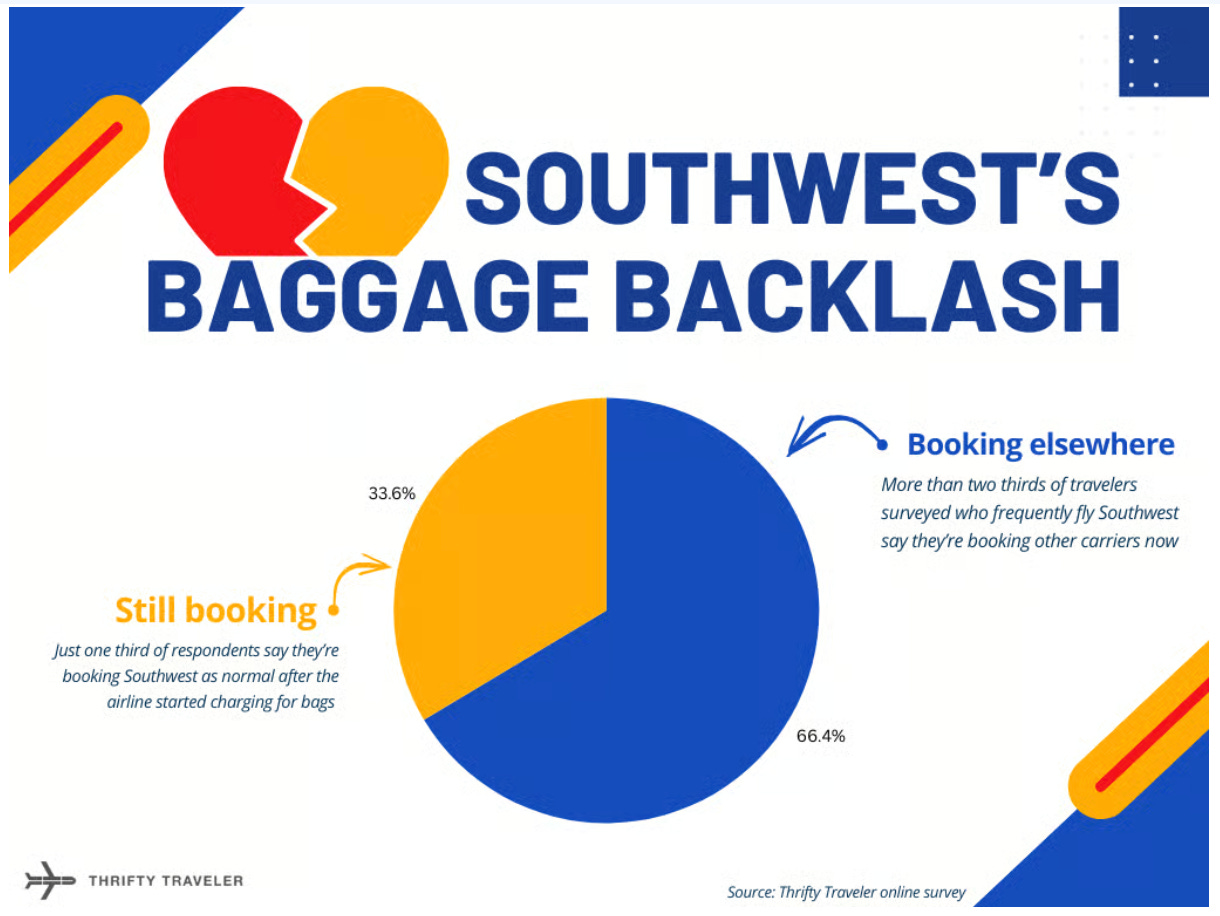
Southwest Airlines — Activist Capture
Southwest held three load-bearing structural commitments for 47 years: point-to-point routing, open seating and bags fly free.
Each was costly by conventional airline economics.
Under Elliott Management’s governance influence, all three were reversed between 2024 and 2025.
Six of the fifteen board members were replaced.
None of the three core commitments was encoded in anything that a new board majority could not reverse in a single strategic cycle.
Forty-seven years of track record turned out to be evidence of how long a commitment can survive before the right external pressure finds the governance gap.
The Threat Environment
Patterns from the past twelve months.
Pinterest — When the people executing the commitment are replaced by software
In January 2025, Pinterest cut less than 15% of its workforce, it was explicitly framed in an SEC filing as a reallocation of resources toward AI-focused roles.
The cuts were concentrated in teams that had been executing human content moderation. The governance document still describes human oversight of content decisions. The operational reality is now AI enforcement with a human appeals window. Those are not the same thing.
Users and creators noticed: 404 Media reported in February 2026 that Pinterest is “drowning in a sea of AI slop and auto-moderation,” with users “exhausted fighting AI moderation.”
The brand governance startup boom — selling the parameter where the commitment used to live
Jasper, Frontify, Typeface, Writer and brand.ai market themselves as brand governance infrastructure: tone of voice enforcement, off-brand detection, style compliance at scale.
Jasper’s positioning is explicit:
“Prevent brand voice violations before they happen.”
Frontify describes its AI Brand Assistant as enforcing guidelines “automatically.”
According to Gartner’s 2025 forecast, 75% of enterprise marketing organizations will use generative AI for content creation by year-end, yet fewer than 30% have established formal governance policies. The tools do not erode distinctiveness. They make the erosion invisible, incremental, and unattributable to any single choice.
The C-suite gap — no shared language for what is actually being traded
McKinsey research published in August 2025, drawing on conversations with executives at over a hundred large global companies, found a deepening disconnect between CMOs, CEOs, and CFOs on what AI investment actually delivers.
“I find a lack of trust and alignment in answering that question,” McKinsey’s Kelsey Robinson said.
The CFO sees AI deployment as a cost-reduction with a clear ROI model.
The CMO sees execution risk but lacks the language to name what is specifically being traded away.
Anthropic’s model constitution — the most rigorous public attempt to encode character into a system
In January 2026, Anthropic published an updated constitution for Claude, a detailed governance document written primarily for the AI model itself.
Anthropic’s Amanda Askell, who led the drafting, described it to Axios as defining Claude’s “ethos,” previously referred to internally as the “soul” doc.
The document establishes a ranked hierarchy of values so that when commitments conflict, the resolution is predetermined rather than improvised.
It names hard constraints explicitly. It acknowledges where the system will fail and what failure looks like.
Most brand governance documents do none of this.
They describe what the organization aspires to sound like.
They do not name the conflicts, the hierarchy, or the failure modes.
The lesson is not that a document can replace human judgment; Anthropic is the first to say it cannot. The lesson is that a governance document that names what happens when commitments conflict is structurally different from one that only describes the aspiration.
Almost no organization outside AI development has written one.
The Filter
“Consumer adoption of AI is better and faster than company adoption to realize the true potential of artificial intelligence.” — Arthur Sadoun, CEO, Publicis Groupe, earnings call, February 2026
The gap between how fast the tool arrives and how slowly the governance catches up is where distinctiveness disappears.
Not in a single decision. In the accumulation of decisions that nobody described as governance decisions at the time.
Hardwired is a monthly newsletter examining the governance, ownership, and structural decisions that protect organizational uniqueness.